Juan Manuel Pérez García de Carellán, PhD student on our team in the Fluid Dynamic Technologies group at the University of Zaragoza, was selected to participate in the 2026 Argonne Training Program on Extreme-Scale Computing (ATPESC), held from July 26 to August 7, 2026, in St. Charles, Illinois (USA).
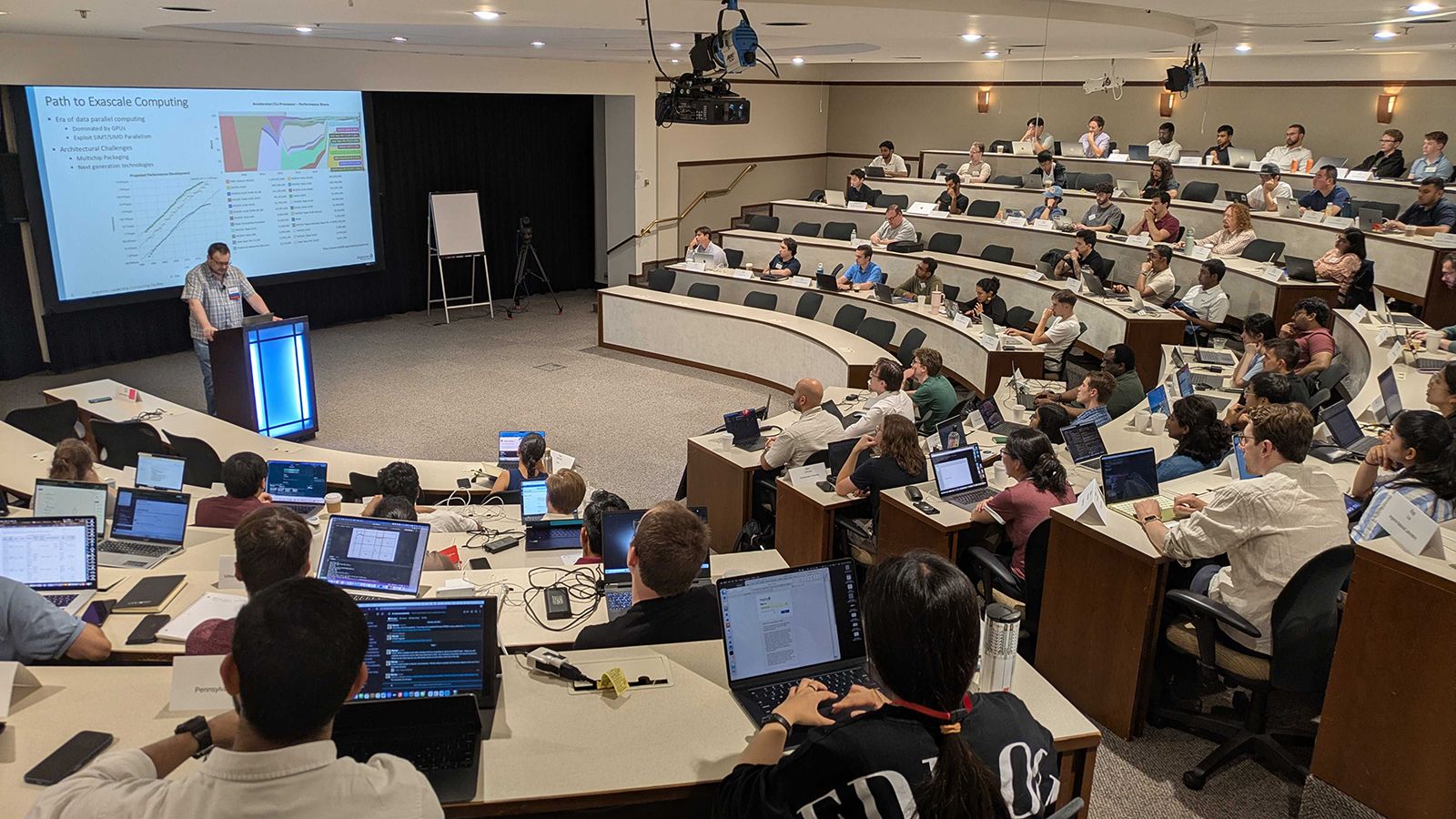
Organized by the Argonne Leadership Computing Facility (ALCF) and funded by the U.S. Department of Energy, ATPESC is an intensive two-week training program focused on the development and application of computational science and engineering methods on current and next-generation high-performance computing (HPC) systems. The program brought together 75 selected participants and provides advanced training through lectures, hands-on laboratory sessions, and direct access to leadership-class computing resources.
During the program, Juan Manuel had the opportunity to strengthen his expertise in high-performance computing, parallel programming, performance analysis, numerical methods, scientific software development, and machine learning. The training included practical work with some of the most advanced computing resources available through the U.S. Department of Energy, providing a unique environment to explore the challenges associated with scientific applications at extreme scale.
This experience is particularly relevant to Juan Manuel’s PhD research, which focuses on the integration of physical and machine learning models for the multi-scale representation of sub-grid features. His research explores the use of deep learning techniques to enhance the spatial resolution of coarse-grid flood simulations, combining the computational efficiency of hydrodynamic models with data-driven approaches to recover fine-scale flow fields.
As part of the training, Juan Manuel also worked with the TRITON hydrodynamic modeling framework on leadership-class supercomputers, gaining practical experience in adapting, compiling, running, and evaluating scientific applications on large-scale HPC architectures. This work provides valuable knowledge for the development of efficient computational tools for high-resolution flood modeling and for the future integration of physical and machine learning models.
Participation in ATPESC 2026 represents an important opportunity to expand the technical capabilities of the group in high-performance and extreme-scale computing. It also strengthens the connection between the University of Zaragoza’s research in computational hydraulics, numerical modeling, and artificial intelligence and the international HPC community, opening opportunities for future collaborations and contributing to the development of more efficient computational approaches for large-scale environmental and hydrodynamic applications.